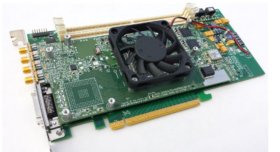
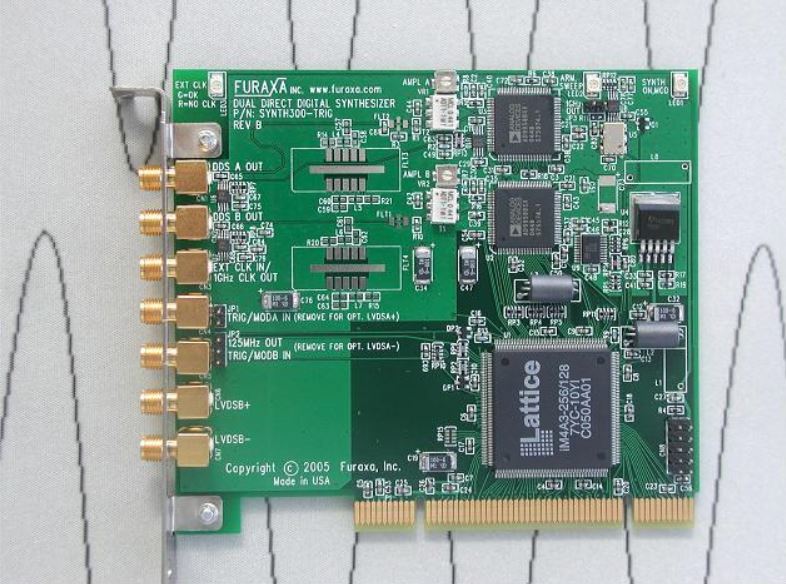
The Synth300-TRIG PCI dual-channel Direct Digital Synthesizers (DDS) card incorporates two independent DDSs synchronized at 1GHz, each separately programmable for frequencies between 300 KHz and 300 MHz in 0.233 Hz increments. In addition to single or dual tone RF generation (500mV into 50 ohms), the SYNTH300-TRIG can generate advanced RF signals such as triggered dwell/sweep/dwell quadrature swept signaling useful in RADAR, RF ATE, and other advanced applications. Additionally, by utilizing the 4 independent user-defined frequency/phase profiles associated with each synthesizer, frequency and/or phase modulated waveforms (4-FSK, 4-PSK) can be easily generated and controlled via software or external TTL inputs. In addition to its two sine-wave RF outputs, the Synth300-TRIG also includes an LVDS port, allowing the user to create a programmable digital clock with precise frequency and phase adjustment capability. It can be ordered with up to 2 such ports (model: Synth300-TRIG-LVDSX2), and will accept an external clock if desired.
Software provided includes a simple-to-use GUI to quickly configure most applications, as well as example C code to allow programming of advanced applications.
Each DDS-based synthesizer holds up to 4 independent frequency/phase profiles. Profile switching can be accomplished via host system software control or by external TTL frequency/phase profile switching inputs, allowing phase and/or frequency to be changed in as little as 8 nanoseconds, for applications in which the time uncertainty of software controlled frequency/phase selection is not acceptable.